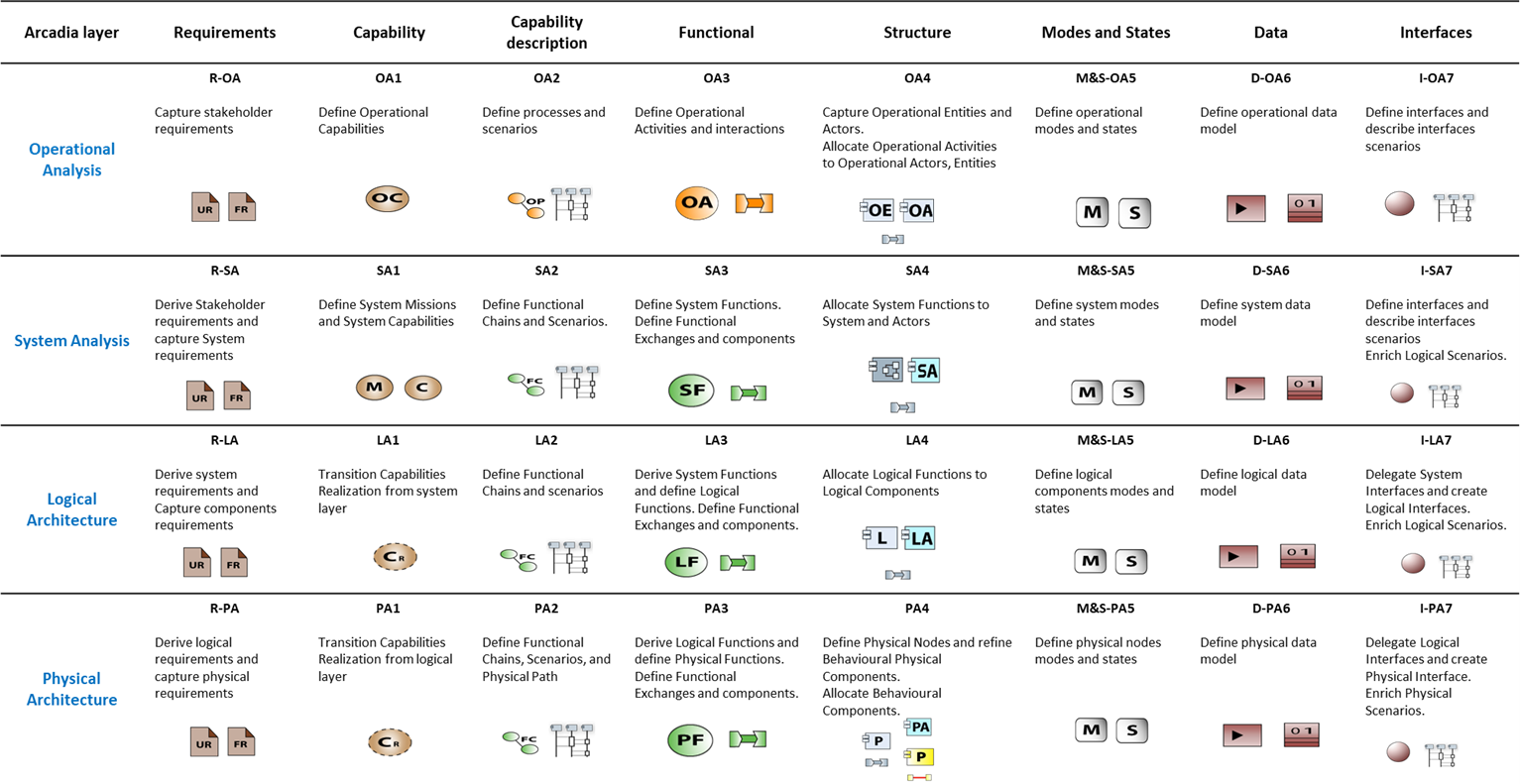
Arcadia is a tooled method devoted to systems & architecture engineering, supported by Capella modelling tool.
It describes the detailed reasoning to
It can be applied to complex systems, equipment, software or hardware architecture definition, especially those dealing with strong constraints to be reconciled (cost, performance, safety, security, reuse, consumption, weight…).
It is intended to be used by most stakeholders in system/product/software or hardware definition and IVVQ as their common engineering reference and collaboration support.
Arcadia stands for ARChitecture Analysis and Design Integrated Approach.
A series of online documents to dive into the principles and concepts of Arcadia:
Arcadia is a system engineering method based on the use of models, with a focus on the collaborative definition, evaluation and exploitation of its architecture.
This book describes the fundamentals of the method and its contribution to engineering issues such as requirements management, product line, system supervision, and integration, verification and validation (IVV). It provides a reference for the modeling language defined by Arcadia.
Jean-Luc Voirin, leader of the creation of the Arcadia method, along with some of the leaders on developing and deploying MBSE Arcadia & Capella practices in Thales. From right to left: Pierre Nowodzienski, Jean-Luc Voirin, Juan Navas, Stephane Bonnet, Frederic Maraux, Gerald Garcia, Philippe Fournies, Eric Lepicier.
Architecture as prime engineering driver
Arcadia, a model-based engineering method
Noticeable features of Arcadia
Definition of the Problem - Customer Operational Need Analysis
Formalization of system requirements - System Need Analysis
Development of System Architectural Design - Logical Architecture (Notional Solution)
Development of System Architecture - Physical Architecture
Formalize Components Requirements - Contracts for Development and IVVQ
Co-Engineering, Sub-Contracting and Multi-Level Engineering
Adaptation of Arcadia to Dedicated Domains, Contexts, Etc.
Equivalences and Differences between SysML and Arcadia/Capella
So, what defines "Girls Do Years Old" entertainment and media content? Here are some key characteristics:
This is the most prominent legitimate media outlet specifically for younger girls (tweens and teens). Recommended for ages 10 to 15. Girls Do Porn - 18 Years Old -E390- -- October REPACK
Many sites with generic names (e.g., "Girls [Age]") may be adult-oriented. Platforms like YouTube and various UK-based sites now enforce strict Age Verification using IDs or AI to prevent minors from accessing mature content. Media Use by Tweens and Teens - Common Sense Media So, what defines "Girls Do Years Old" entertainment
: Content analysis shows that once women reach middle age, they often face "symbolic annihilation" in media, either disappearing from screens or being relegated to limited, secondary roles, in sharp contrast to male actors who remain action leads well into their sixties. Digital Media Consumption (Teen Girls) Many sites with generic names (e
As girls enter elementary school, their interests expand to include more complex stories and characters. Popular entertainment and media options for this age group include:
Created by Lena Dunham, this series is often associated with "girls" and "years old" because it chronicles the lives of four women in their 20s as they navigate early adulthood. Adults only (18+) due to graphic content.
The landscape of entertainment and media for girls varies significantly by developmental stage, shifting from curated educational programming in early childhood to highly personalized, social-driven content in the pre-teen and teenage years. Content and Media Habits by Age