
• youtube
  • linkedin
  • twitter
  • Facebook
  • Help
  • News
  • Home
introduction to numerical analysis gupta and bose pdf %7CBEST%7C
  • Home
  • Our Products
    • An Overview
    • TimeTabler
    • Options
    • StaffCover
    • The Timetabler’s
      CookBook
    • The TOOLS
      online System
    • FAQs
    • Links to MIS
    • Help & Support
  • Our Schools
    • Comments
      & Testimonials
    • TimeTabler around
      the World
    • Existing customer ?
      Upgrades & Renewals
    • TimeTabler for MATs
  • How to order
    • Tutorial Versions
      (try before you buy)
    • Book an Online Demo
    • FAQs
    • Users’ Comments
    • New customer ?
      Order Now
    • Existing customer ?
      Upgrades & Renewals
    • How to Pay
  • Help & Support
    • Help in 12 ways
    • New To Timetabling?
      Skills, principles, etc
    • Moving from Nova-T6
    • Free Timetabling Booklets
    • Support Centre
    • Training & Courses
      On-site, workshops,
      webinars, etc
    • Help Movies
    • Exporting to your MIS
    • Upgrades & Renewals
  • Downloads
    • Free Downloads
    • TimeTabler Tutorial
    • Options Tutorial
    • StaffCover Tutorial
    • Free Timetabling Booklets
    • Principles & materials
    • Physics teaching
    • Readability tests
    • Lesson Loader
  • Contact Us

Introduction To Numerical Analysis Gupta And Bose Pdf %7cbest%7c //free\\ 〈SECURE »〉

Workshops - TimeTabler Free Downloads

Introduction To Numerical Analysis Gupta And Bose Pdf %7cbest%7c //free\\ 〈SECURE »〉

: For those with an academic subscription, a similar title, Elements of Numerical Analysis by Radhey S. Gupta, is available as an online PDF/ePUB on Perlego .

For students of mathematics, computer science, and engineering, particularly those navigating the rigorous curriculums of Indian universities, this book remains an essential companion. It serves as a reminder that in a world of infinite precision, the ability to manage error and approximation is the true mark of a mathematician. : For those with an academic subscription, a

Riya typed the query exactly as it had been scribbled in her notebook: "introduction to numerical analysis gupta and bose pdf %7CBEST%7C". It was messy, half a library reference and half an internet breadcrumb. She hit Enter out of habit, expecting the usual list of PDFs and textbook snippets. Instead, the browser returned a single unusual result: an old forum thread titled "The Book That Taught a Village to Count." It serves as a reminder that in a

: Includes single-step (Euler, Runge-Kutta) and multi-step (Adams-Bashforth, Milne) methods. Key Features Algorithmic Approach She hit Enter out of habit, expecting the

: Practical coverage of matrix inversion, LU-Decomposition, and power methods for eigenvalues.

The book is divided into 10 chapters, each covering a specific topic in numerical analysis. The contents of the book are as follows:

introduction to numerical analysis gupta and bose pdf %7CBEST%7C

The TimeTabler Newsletter

Our free Monthly Newsletter for School Timetablers:  Click here for more info, or to sign-up.

Logo

October Resolutions

  • About Us
  • Contact Us
  • Careers at TimeTabler
  • Data & Privacy
  • – – – – – – – – – – –
  • Help & Support
  • Associates & Training

Our Software

  • TimeTabler
  • Options / Electives
  • StaffCover
  • – – – – – – – – – –
  • Free Tutorials
  • Add to Wish-List
  • How to Buy

Extras & Services

  • Timetabler’s CookBook
  • TOOLS (for Options)
  • Training & Courses
  • – – – – – – – – – –
  • Free Resources
  • New To Timetabling ?
  • Gold-Start Support

Stay in contact

  • Contact Us
  • Read our Blog/News
  • ----------
  • Social Media
  • ----------
  • Tell a Friend
  • Our NewsLetter

© 1979-2026 October Resolutions Ltd

  • Terms & Conditions
Basic Data

BasicData-thumbnail

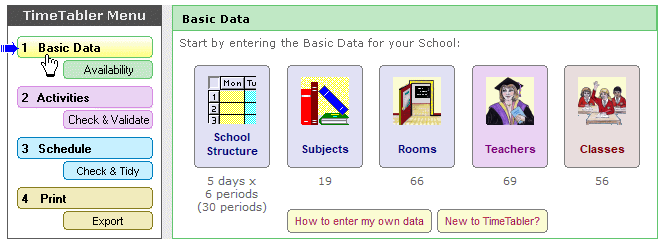
This shows the Main Menu, and Step 1 : the Basic Data screen, with five big buttons.

Each button leads you to an entry screen.

To enter your data you would start at the left, and work your way across to the right.

Look how straightforward it is, compared to other programs !

And the fully-illustrated printed Manual explains each step, in detail.

Subjects Screen

subjects screen

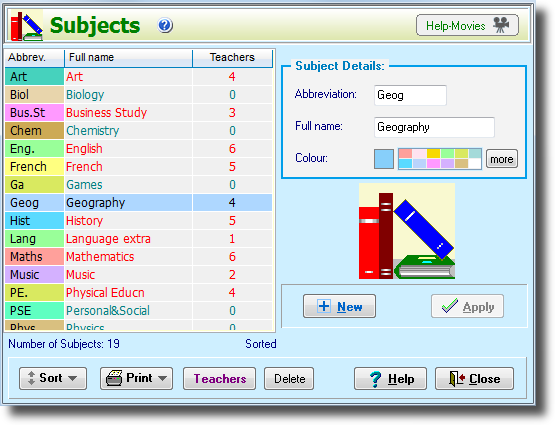
This is the screen for saying which Subjects you will want to timetable.

You can return here at any time to edit / alter your data.

You can give each Subject a colour – this helps during scheduling, and for the printouts.

Visual Builder Screen

visual builder screen

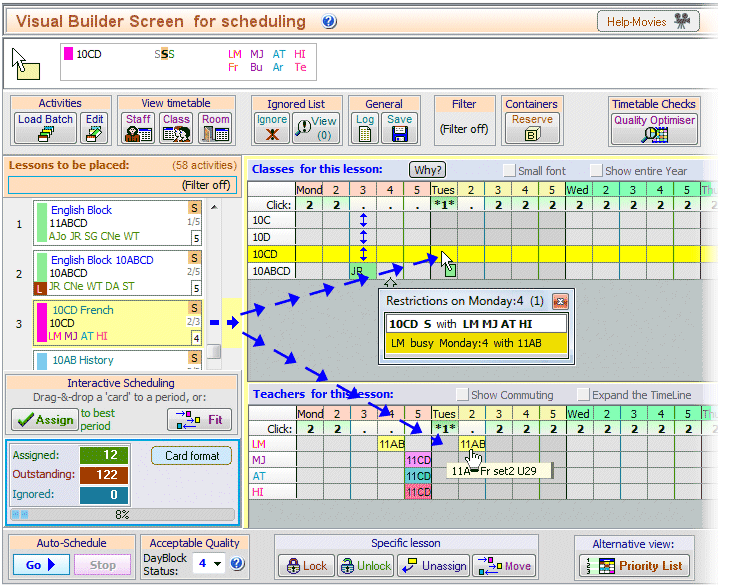
This is the main screen on which you do the actual scheduling.
You can sit at this Visual Builder Screen and drag-and-drop to ‘drive’ through the timetable.
 
At first sight it looks very complicated.  To see what each part will do for you, please click on: www.timetabler.com/kb/UsingtheVisualBuilderScreen.pdf

Class Timetable Screen

visual builder screen

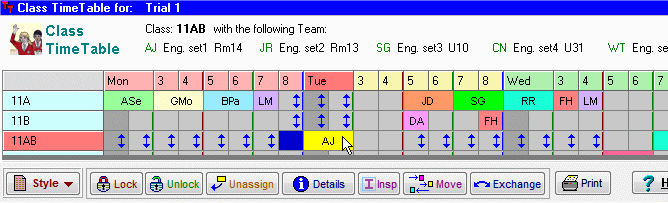
This shows you the Class Timetables, so you can see the pattern while you are scheduling lessons.
  
There are similar screens for the Staff Timetables and for the Room Timetables.
 
If you use dual monitors you can see these more easily and spread them out over the bigger area.

All the buttons, and the symbols, are explained when you click on the introduction to numerical analysis gupta and bose pdf %7CBEST%7C button.

The Printout Menu

introduction to numerical analysis gupta and bose pdf %7CBEST%7C

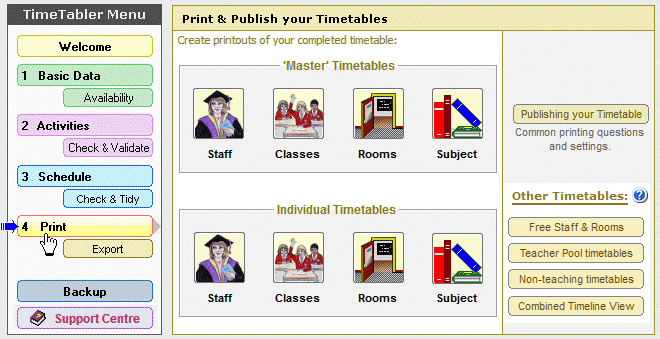
This shows you some of the possibilities for the Printouts.
 
Within each of these, there are millions of ways of fine-tuning the exact design of the Printouts.

They can be printed on paper, or produced as web-pages, at the click of a button.

A professional result.
 

The 'master' Class Printout Screen

Class timetable printout screen

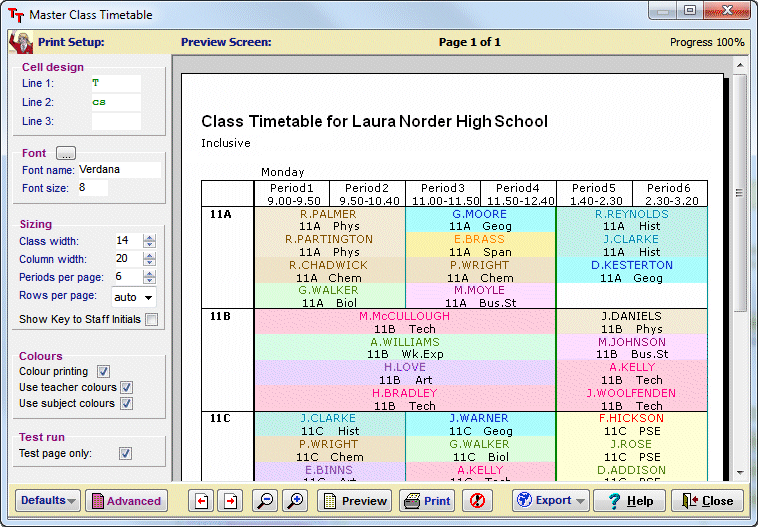
This shows you the Preview Screen , so you can design the ‘master’ Class printout, before printing it.
 
There are similar screens for the Staff Timetables and for the Room Timetables.
 
You have total control over the design, the font and the colour, the column widths, the labels, etc, etc.
 
All the buttons and the controls, are explained when you click on the introduction to numerical analysis gupta and bose pdf %7CBEST%7C button.